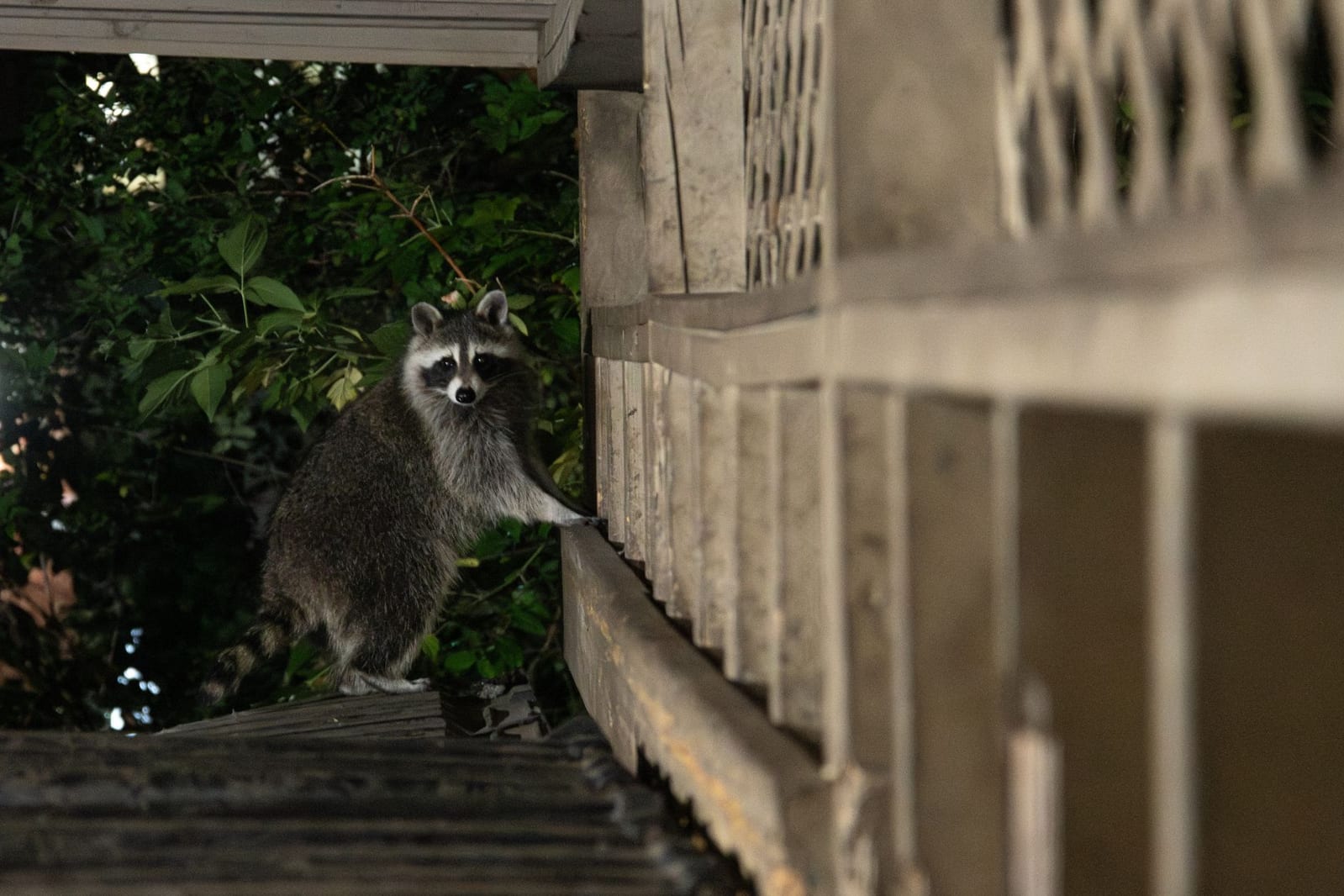
Wildlife pressure in Inwood exists for a simple reason: Inwood Hill Park is the only natural forest left on Manhattan island, and it sits directly beside the neighbourhood's housing stock. Squirrels and raccoons that would never reach most Manhattan blocks have a direct route onto roofs and into attics on streets closest to the park.
Squirrels typically enter through gaps in roofing, loose fascia boards, or overhanging tree limbs — all more common on Inwood's park-adjacent blocks than on the denser interior streets toward Washington Heights. Raccoons favour chimneys and larger roofline gaps, and both species are most active seeking entry as the weather turns in autumn.
Because relocation of nuisance wildlife is restricted under New York State DEC rules, we lead every job with exclusion — sealing every entry point except one, letting the animal leave, then closing the last gap — rather than treating removal as the whole job.
Getting wildlife out of an attic safely — what NYC homeowners should know
Per the CDC, raccoons and bats are the primary rabies-reservoir species in the eastern US — together they account for the majority of animals that expose Americans to rabies, and raccoons are an established reservoir along the entire Eastern seaboard. That is why grounded or daytime-active nuisance wildlife should never be handled directly and is a job for a trained operator. (CDC — Rabies in the United States)
The CDC notes raccoon roundworm (Baylisascaris) lives in raccoons and is shed in their droppings; people are infected by accidentally swallowing eggs from contaminated soil or surfaces, and although rare, infection can be severe when larvae invade the eye, organs or brain. So a raccoon latrine in an attic needs careful clean-up, not just animal removal. (CDC — About Raccoon Roundworm)
Penn State Extension stresses that trapping or evicting a nuisance animal only works long-term when paired with exclusion — sealing every foundation and structural opening — because an open structure is simply reoccupied by new animals. Removing denning sites and sealing entries is the durable fix, not removal alone. (Penn State Extension — Nuisance Wildlife Solutions)
Penn State Extension warns that bats must never be sealed out during the maternity season (late May to mid-July), because flightless pups would be trapped and die inside. Humane exclusion uses one-way devices timed for spring before bats arrive or late summer and fall after pups can fly, then entry points are permanently sealed. (Penn State Extension — Timing for Excluding Bats)
How much does wildlife & squirrel removal cost in NYC?
$150–$600
Squirrel removal: $200–$600 (typical $250–$450, avg ~$300). Raccoon removal: $300–$450 avg, or $150–$300 per animal for trap-and-release. Exclusion vent installation: $300–$450 each. One-way mesh exclusion barrier: $10–$25/linear foot.
| Squirrel removal | $200–$600 one-time |
| Raccoon removal | $150–$450 one-time |
| Exclusion vent installation | $300–$450 per vent |
US national figure — NYC typically runs higher.
Market range — not our quote
This is a market range synthesised from published cost guides — not a quote from this provider. The actual price depends on an in-person or photo-based inspection.
US national — NYC typically higher. No NYC-specific wildlife-removal cost guide found despite NYC's well-documented raccoon/squirrel-in-building problem — a genuine gap versus the bed bug/rat/roach guides.
What drives the price
- Species
- Number of animals
- Location (open yard vs attic/wall void)
- Cleanup/repair needed after removal (droppings, insulation, entry-point damage)
Signs you have a wildlife removal problem
- Scratching or scampering in the attic or ceiling, especially at dawn or dusk
- Gnawed or torn fascia boards, soffit panels, or roofline gaps facing the park
- A raccoon or squirrel seen entering/exiting a chimney or roof gap on a park-adjacent block
- Droppings in an attic or chimney cavity
- Tree limbs overhanging the roofline close enough to give direct access
Why Inwood sees this
Inwood Hill Park is the only natural forest remaining on Manhattan island, giving Inwood a wildlife-pressure profile — squirrels, raccoons — that most of the borough simply doesn't have.
New York State DEC rules restrict relocating nuisance wildlife more than a short distance, which is why exclusion (not just trapping) is the standard approach here.
Blocks closest to Inwood Hill Park see more wildlife entry activity than interior streets toward Washington Heights, which shapes where we focus the roofline inspection.